What Is a Wall of Love and How to Build One
A wall of love is a page full of real customer praise. Here's what goes on one, how it differs from a testimonial section, and how to build one in an afternoon.
Edvin Åslund
Founder of Aboast
If you've browsed SaaS websites for a while, you've seen one: a long page of customer tweets, quotes and reviews, laid out like sticky notes on a board, usually titled "Wall of Love." It's one of the simplest pieces of social proof you can build, and one of the few that gets better on its own as you grow.
This guide explains what a wall of love is, how it differs from the testimonials on your landing page, what to put on it, and how to build one in an afternoon.
What is a wall of love?
A wall of love is a page (or a large section of one) that collects lots of real customer praise in one place: testimonials, social media posts, review-site reviews, kind emails, short videos. Where a landing page testimonial is carefully chosen to answer one doubt, a wall of love works through volume and variety. The message isn't "this one customer is happy." It's "look how many people, of how many different kinds, are happy."
The name stuck because of how it looks: dozens of cards in a masonry layout, each one a small note of thanks.
Wall of love vs testimonial section vs case study
These three do different jobs, and most sites benefit from all three.
| Testimonial section | Wall of love | Case study | |
|---|---|---|---|
| Job | Answer a specific doubt | Show breadth and volume | Prove a result in depth |
| Where | Next to the claim it supports | Its own page, linked widely | Its own page, used in sales |
| How many | 1–3 at a time | As many as you have | One customer per story |
| Picked for | Relevance to the spot | Variety | A strong before/after |
| Who reads it | Every visitor | The curious and the cautious | Serious buyers late in the decision |
So a wall of love doesn't replace the quotes on your landing page. It's where those quotes come from, and where a visitor who wants more proof goes next. For the landing page side, see where to put testimonials on your landing page. For in-depth stories, see B2B SaaS case studies that actually get read.
What to put on a wall of love
Anything a real customer said about you, with their permission:
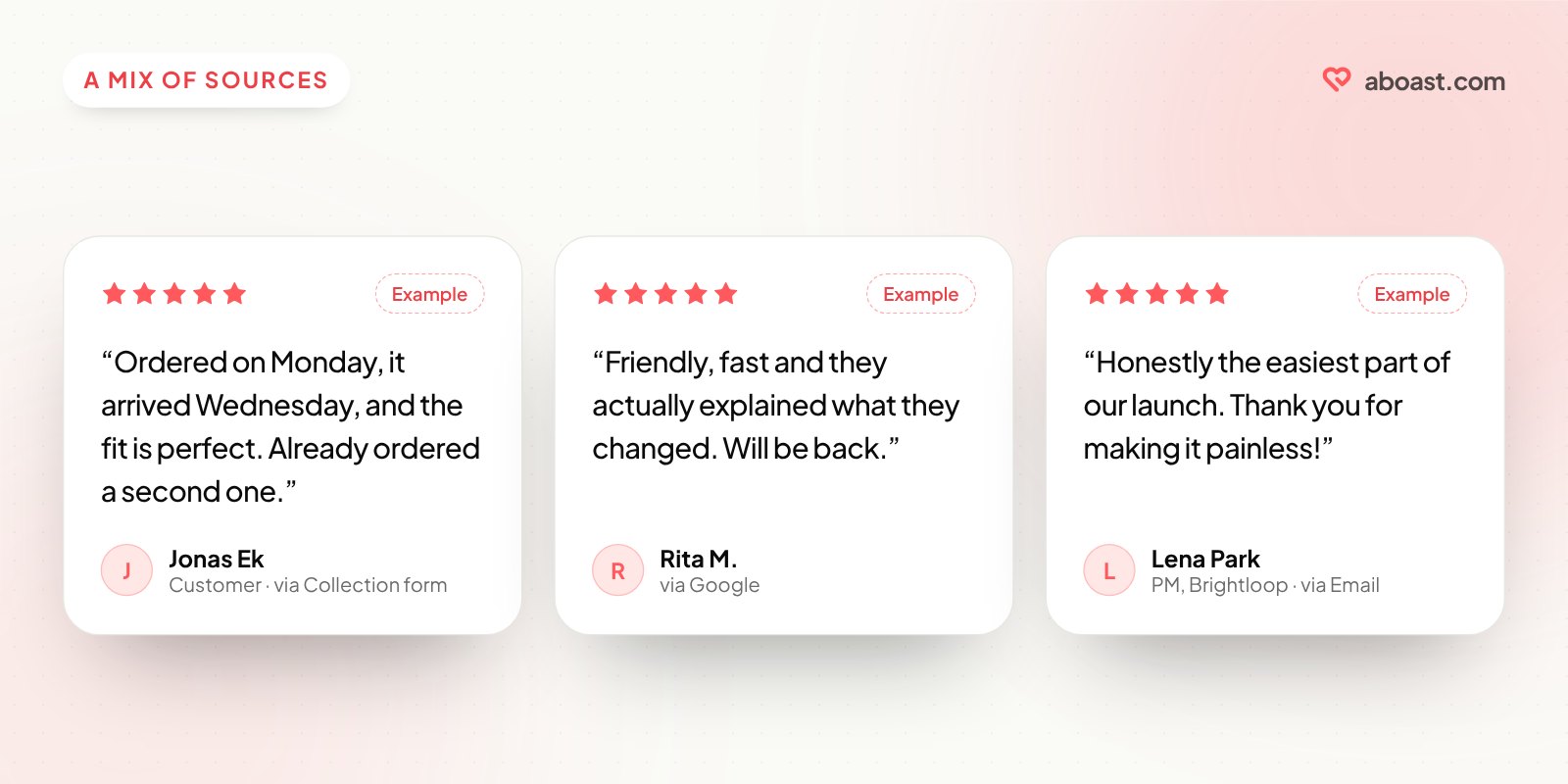
- Form submissions — testimonials customers wrote for you directly.
- Social posts — tweets, LinkedIn posts or Threads posts that mention you. Ask the person before you feature them.
- Emails and chat messages — that lovely reply to your onboarding email counts. Ask if you can quote it.
- Review-site reviews — Google, Trustpilot, Yelp or Tripadvisor reviews, labeled with where they came from.
- Short videos — even one or two make the wall feel more alive.
Variety matters more than polish. A wall where every quote is the same length and tone looks curated. A mix of one-liners, longer stories, star ratings and the occasional emoji looks like real people, because it is.
How to build a wall of love in an afternoon
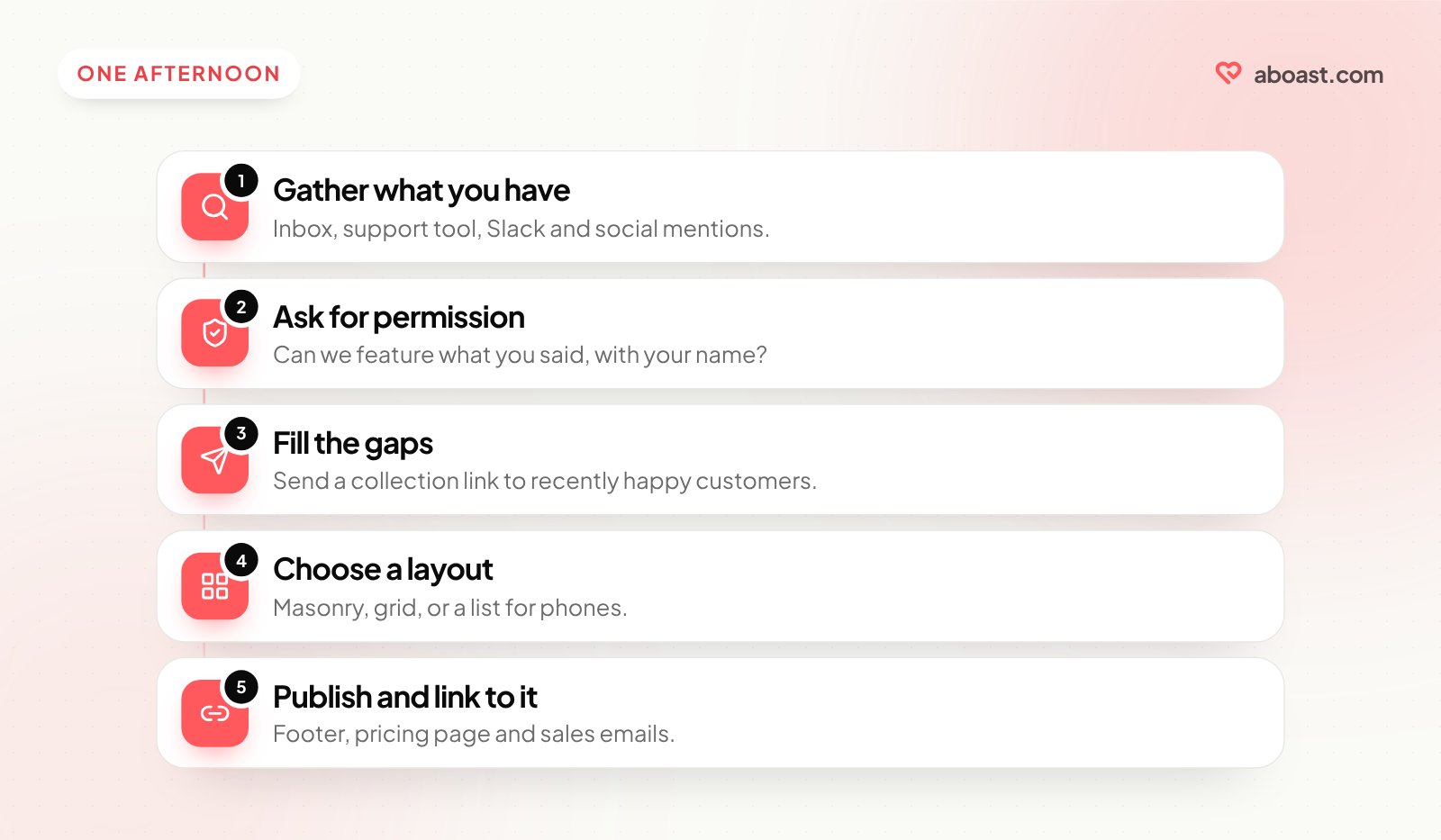
1. Gather what you already have (about an hour). Search your inbox, support tool, Slack and social mentions for praise. Most teams find more than they expected — they just never kept it anywhere.
2. Ask for permission where you need it (15 minutes). For anything that wasn't submitted as a testimonial, send a short note: "Can we feature what you said on our website, with your name?" Most people say yes.
3. Fill the gaps with a collection link (15 minutes). Send a short form to a handful of recently happy customers. How to ask for a testimonial has wording you can copy, and testimonial questions to ask customers has the prompts.
4. Choose a layout (15 minutes). Masonry is the classic wall-of-love look because cards of different lengths fit together neatly. A grid feels tidier; a list is easiest to read on phones.
5. Publish it on its own page and link to it (30 minutes). Give it a clean URL like /love or /customers, and link to it from your footer, your pricing page, the bottom of your landing page and your sales emails.
Design tips that make a wall of love believable
- Show real names, roles and photos. Anonymous quotes are the first thing skeptical visitors discount.
- Show the source. "via Google" or a small X logo tells visitors the quote exists outside your website.
- Show dates, or keep it fresh. A wall where the newest quote is two years old raises questions.
- Lead with your strongest and most varied quotes. The first screen decides whether people keep scrolling.
- Keep the page fast. Lots of avatars and videos add up; lazy-load what's below the fold.
Mistakes to avoid
- Featuring screenshots without permission. Public doesn't mean "free to use in your marketing."
- Editing quotes until they sound like ad copy. Trim, don't rewrite.
- Writing or "improving" testimonials yourself. Beyond being dishonest, fake reviews and testimonials are illegal in many places, including under the FTC's rules in the US.
- Building it once and forgetting it. A wall of love should grow every month.
Building one with aboast
In aboast, a wall of love is a built-in page. You choose a title and description, a masonry, grid or list layout, the number of columns, and whether to show star ratings, dates and company names. You then get a shareable link and an embed code if you'd rather put it on your own /love page.
It pulls from the same testimonial inbox as everything else: form submissions, testimonials you add by hand, and reviews you import from Google, Trustpilot, Yelp or Tripadvisor. Approve a new testimonial and it appears on the wall — no editing the page.
Wrap-up
A wall of love is the easiest social proof to build and the one that compounds: every happy customer makes it a little more convincing. Gather what you have, ask for permission, fill the gaps with a collection link, publish it on its own page, and link to it from everywhere a visitor might want more proof.