20 Testimonial Questions to Ask Customers (and Why They Work)
20 testimonial questions to ask customers, grouped by what you need: the problem, the result, the doubts they had, and quotes for pricing pages and case studies.
Edvin Åslund
Founder of Aboast
Most testimonials are forgettable for one reason: the question that produced them. Ask "How was your experience?" and you get "Great product, highly recommend!" — true, kind, and useless on a landing page.
The fix isn't finding better customers. It's asking better testimonial questions. The right questions get you specific answers with a before, an after, and a real reason to believe. Below are 20 testimonial questions to ask customers, grouped by what you need the answer for, plus how many to ask and which ones to avoid.
Why the question decides the testimonial
A customer filling in a form has about a minute of attention to give you. If the question is vague, they spend that minute deciding what to say, and settle on something generic. If the question is specific, they spend it remembering something real.
Compare the answers these two questions tend to get:
| Question | Typical answer |
|---|---|
| "How was your experience with us?" | "Really great, the team was super helpful!" |
| "What were you doing before, and what's different now?" | "We used to chase testimonials over email and paste them into Figma. Now they come in through one link and show up on our pricing page." |
The second answer has a problem, a change and a detail. That's what makes a reader think "that's me."
The before → after → proof structure
The most convincing testimonials follow the same shape:
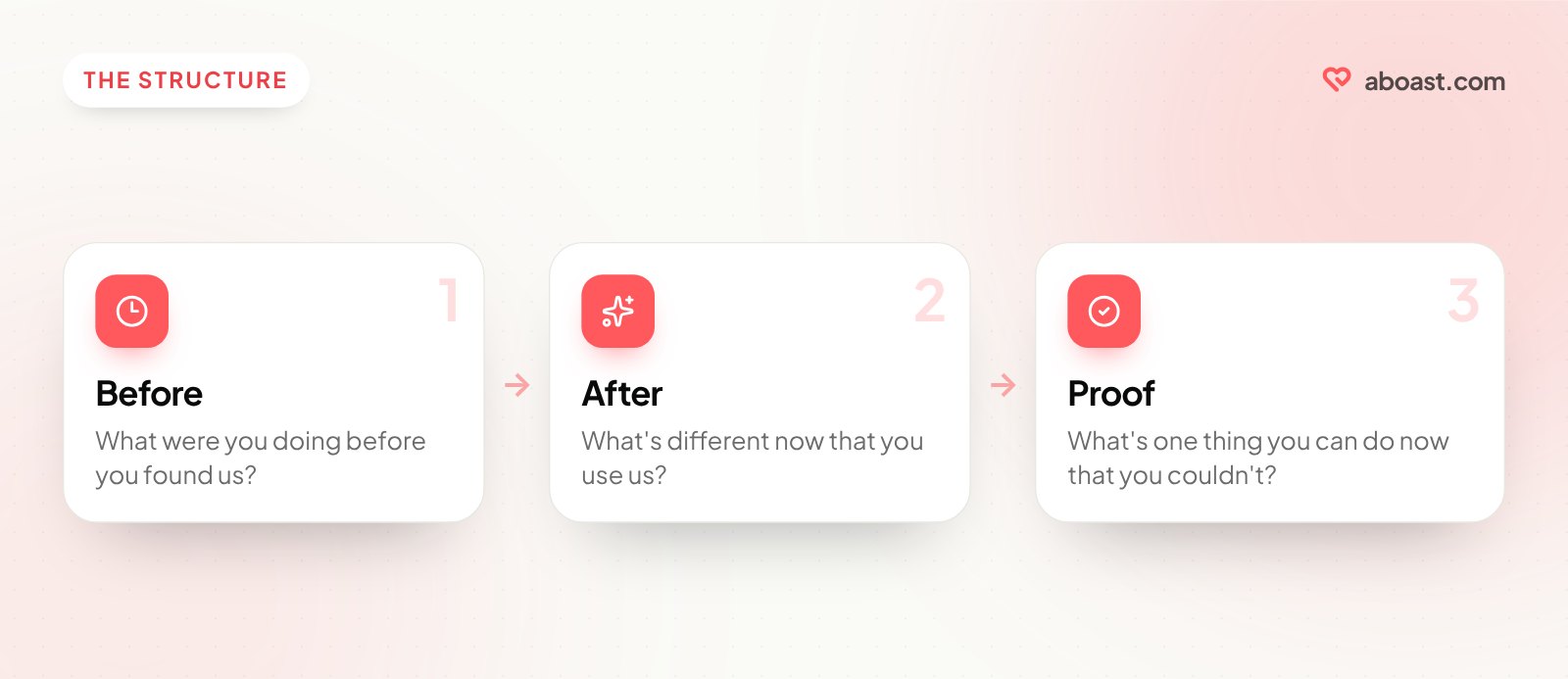
- Before — the problem or frustration the customer had.
- After — what changed once they started using you.
- Proof — a detail, number or moment that makes it believable.
You don't need the customer to know this structure. You just ask one question for each part, and the testimonial assembles itself.
Questions about the problem (the "before")
- What were you trying to get done when you found us?
- What were you using before, and what wasn't working about it?
- What was the most frustrating part of how you did this before?
- What made you start looking for something new?
- What would have happened if you hadn't solved this?
These give your testimonial its stakes. Without a "before," an "after" has nothing to compare against.
Questions about the result (the "after")
- What's different now that you use us?
- What's one thing you can do now that you couldn't before?
- Roughly how much time does this save you in a typical week?
- What was the first moment you thought, "okay, this works"?
- What has your team or your customers noticed?
Question 8 is worth asking even though some people won't answer it. When someone does give a number, it's a number in their own words — far more believable than one you'd write.
Questions about the decision (the doubts)
- What almost stopped you from signing up?
- Was there anything you were skeptical about at first?
- What made you choose us over the alternatives you looked at?
- Was it worth the price? Why?
- What would you tell a friend who's on the fence?
These are the most underrated testimonial questions. A prospect reading your page has the same doubts your customer once had. A quote that names a doubt and then resolves it — "I wasn't sure it was worth paying for, but..." — answers an objection in a voice the prospect trusts more than yours. They're ideal for pricing page testimonials.
Questions for specific uses
- For a landing page: In one sentence, how would you describe us to a colleague?
- For a pricing page: Which plan are you on, and what made it the right one?
- For a feature page: Which feature do you use most, and what does it replace?
- For a case study: Can you walk me through how you set things up in the first week?
- For a video: In 30 seconds, what would you tell someone in your shoes?
Number 16 is a favourite because the answer is short enough to use as a headline-sized quote, and it's in the customer's words, not marketing language.
How many questions to ask
On a form, three questions is the sweet spot: one before, one after, one proof or doubt. Make one of them required and the rest optional. Add a star rating, name, job title and company, and stop there.
| Where you're asking | How many questions | Which ones |
|---|---|---|
| Testimonial form | 2–3 | One each from before, after, and doubts |
| Email reply | 1 | Usually #6 or #9 |
| Customer call | 5–8 | Mix all groups, follow up on anything interesting |
| Video request | 2–3 | #1, #6 and #20 as speaking prompts |
Longer forms don't produce longer answers. They produce abandoned forms.
Questions to avoid
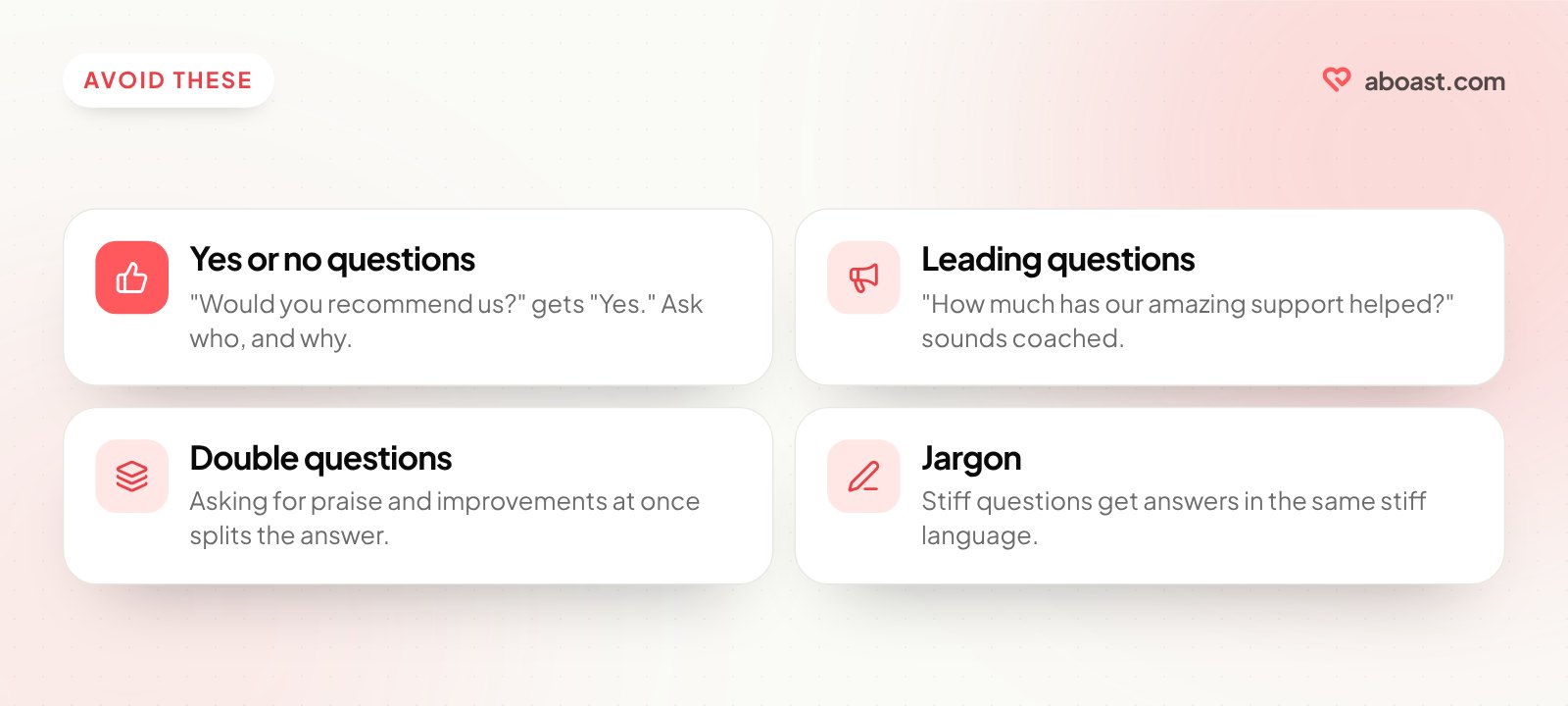
- Yes/no questions. "Would you recommend us?" gets "Yes." Ask "Who would you recommend us to, and why?"
- Leading questions. "How much has our amazing support helped you?" reads as fishing, and the answer sounds coached.
- Double questions. "What did you like and what could we improve?" splits the answer in two. Ask for improvement feedback separately.
- Jargon. "How has our platform impacted your workflow efficiency?" gets an answer in the same stiff language.
Setting it up in a form
Paste your three questions into whatever collection form you use as the field labels, and use the placeholder text to show what a good answer looks like — for example, "e.g. We used to copy reviews by hand from emails...". A short example nudges people toward specifics without putting words in their mouth.
In a tool like aboast, each form has its own questions, so you can run a few side by side: a general form for your email signature, a "just upgraded" form with question 14 for pricing quotes, and an onboarding form with question 9. Each form can tag its submissions automatically, so pricing-page quotes are easy to find later.
Turning answers into a testimonial
Customers rarely answer in one perfect quote. You'll get three short answers that need light assembly. That's fine, as long as you:
- Keep their words. Trim and join sentences, but don't add claims or swap in your own phrasing.
- Keep the order. Before, after, proof — usually the order they answered in.
- Ask before publishing. Send the edited version back: "Does this still sound like you?"
For the outreach side — when to send the form and what to say — see how to ask for a testimonial and testimonial request emails that actually get replies.
Wrap-up
Better testimonials start with better questions. Ask about the before, the after and the doubts, keep it to three questions, and let the customer's own words do the selling. Get those testimonial questions right once, put them in a form, and every testimonial after that gets better on its own.